Substack: The Varieties of Transitional Experience: Nirav Soni with Vanessa Sinclair
Psychoanalytic Quarterly Editorial board member Nirav Soni is in conversation with Vanessa Sinclair as part of his Substack video series “The Variety of Transitional Experience,” one of several Substack series produced by The Quarterly. For more, visit our Substack HERE
We also encourage you to explore Vanessa Sinclair’s podcast: “Rendering Unconscious” HERE
About Nirav Soni’s Substack Series: Winnicott’s transitional object and transitional phenomena concept has had an immeasurable impact on our understanding of the analytic process. Much of the theorizing of contemporary intersubjectivity turns on this concept, which Winnicott described as “the third part of the life of a human being, a part that we cannot ignore, is an intermediate area of experiencing, to which inner reality and external life both contribute.” Psychoanalytic scholarship of the last fifty years has worked out the implication of this concept for psychoanalytic process, but outside of the treatment process the elaboration of the concept of transitionality has focused somewhat concretely on aesthetic objects, mostly artworks that serve to help adults enter the realm of imagination and play. In Nirav Soni’s Substack series, he presents a number of essays, sketches, interviews, and reflections that do not presuppose that we understand what transitional experience is or what counts as an example of it. Instead, using a wide variety of topics—some related to aesthetics, but also covering sport, education, community mental health, and more—the series approaches transitional experience in an expansive way that may show what this idea holds for future generations.
About Vanessa Sinclair: Vanessa Sinclair, Psy.D. is a psychoanalyst based in Sweden, who works remotely online with people all over the world. She is the founder and director of Rendering Unconscious Center for Psychoanalysis and hosts the internationally renowned podcast “Rendering Unconscious,” which was awarded the Gradiva Award for Digital Media by the National Association for the Advancement of Psychoanalysis (NAAP). Dr. Sinclair is the author of Things Happen (2024), Scansion in Psychoanalysis and Art: The Cut in Creation (2021), The Pathways of the Heart (2021) and Switching Mirrors (2016). Sinclair is also the editor of Psychoanalytic Perspectives on the Films of Ingmar Bergman: From Freud to Lacan and Beyond (2023), as well as the Rendering Unconscious: Psychoanalytic Perspectives (2024) book series. She co-edited The Queerness of Psychoanalysis: From Freud and Lacan to Laplanche and Beyond (2025) with Elisabeth Punzi and Myriam Sauer, as well as Outsider Inpatient: Reflections on Art as Therapy (2021) with Elisabeth Punzi, On Psychoanalysis and Violence: Contemporary Lacanian Perspectives (2019) with Manya Steinkoler, and The Fenris Wolf 9 (2017) and The Fenris Wolf 11 (2022) with Carl Abrahamsson. She is a founding member of Das Unbehagen: A Free Association for Psychoanalysis, sits on the International Advisory Board for the journal Psychoanalysis, Culture & Society, and is Editorial Advisor for Parapraxis Magazine. (Photo of Sinclair by Carl Abrahamsson)
About Nirav Soni: Nirav Soni, PhD is an Assistant Clinical Professor of Psychology in Psychiatry at Weill Cornell Medical College. He is on the faculty of the DeWitt Wallace Institute for the History of Psychiatry where he directs a fellowship program for second and third year psychiatry residents in the history of psychiatry. He also teaches and supervises in the psychology internship program at Cornell. He did his analytic training at the Columbia Center for Psychoanalytic Training and Research where he is now on the faculty. He is in private practice in Princeton, NJ and NYC.
Quarterly Conversations:
Neal Vorus with Jason A. Wheeler Vega
This Quarterly Conversation is on the occasion of our July 2026 special issue, which is dedicated to Lucy LaFarge (1948-2025). LaFarge was the E-I-C of the Quarterly from 2021 until 2024 when she stepped down due to a recurrence of cancer. This special issue includes a reprint of LaFarge’s “The Imaginer and the Imagined” and five commentaries on her paper, including one by Jason A. Wheeler Vega. Wheeler Vega’s paper and Lucy LaFarge’s paper are free access through October 30, 2026.
Here, the Quarterly’s Editor-in-Chief, Neal Vorus and Wheeler Vega explore his paper “Beyond knower and known: The evolution of a personal core theory in ‘The Imaginer and the Imagined’ and related works.” They discuss, among other topics, LaFarge’s “personal core theory” of psychoanalysis and her thinking around what she called “memorial tokens,” as well as Wheeler’s personal memories LaFarge. In his abstract for “Beyond the Knower and the Known” Wheeler Vega begins: “LaFarge’s ‘The Imaginer and the Imagined’ (2004) is read both for its position within the development of her personal core theory of psychoanalysis (LaFarge 2017) and as part of an approach (if not a solution) to wider problems about such roles as knower and known, doer and done-to, and most broadly self and other.”
Jason Wheeler is a British-American psychologist and psychoanalyst, a graduate of the Psychoanalytic Association of New York where he is Chair of the Consultation and Treatment Service and currently teaches a course on dreams and dreaming. He also serves on the Editorial Boards of The Psychoanalytic Quarterly and The International Journal of Psychoanalysis. His interests include fundamental aspects of the psychoanalytic situation and sexuality and gender. He works with individuals and couples in NYC.
The other four commentaries in this special issue are written by: Catalina Bronstein, Giuseppe Civitarese, Richard B. Simpson, and Judith A. Yanof.
PQ re/view: Rodrigo Barahona with Stephen Grosz
For the Quarterly’s October 2026 issue, our Book Review Editor Rodrigo Barahona interviewed writer and analyst Stephen Grosz about his newest book Love’s Labor: How We Break and Make the Bonds of Love. The Quarterly will publish a review of Stephen’s book written by Sarah Ackerman in October 2026.
Stephen Grosz is a practicing psychoanalyst in London and the author of The Examined Life and Love’s Labor. Born in America, he was educated at the University of California, Berkeley, and at Oxford University, and has worked with patients for more than forty years. The Examined Life, a number one “Sunday Times” bestseller, has been translated into more than thirty languages and was praised by Michiko Kakutani in “The New York Times” for its “slim, piercing chapters” that read “like a combination of Chekhov and Oliver Sacks.” His second book, Love’s Labor, published by Random House in 2026, explores the complexities of love through psychoanalytic case histories. Tara Westover describes Love’s Labor as “a profound meditation on love and healing,” and Zadie Smith wrote that Grosz “generously shares his wisdom with the rest of us.”
Rodrigo Barahona, Psya. D., is a faculty member at the Boston Psychoanalytic Society and Institute and the Massachusetts Institute for Psychoanalysis. He is on the board of directors at the Psychoanalytic Quarterly, where he is also the Book Review Editor, and serves on the editorial boards of “The International Journal of Psychoanalysis,” “The Psychoanalytic Quarterly,” and formerly on the “:Journal of the American Psychoanalytic Association.” He is the guest editor of the October 2026 special issue of The Psychoanalytic Quarterly, “Bion at 20,000 feet,” which examines Wilfred Bion’s influence across the world and will feature papers by Howard Levine, Nicola Abel-Hirsch, Dana Amir, Clara Nemas, Giuseppe Civitarese, and Joseph Aguayo. Dr. Barahona has a private psychoanalytic practice in Brookline, Massachusetts.
Quarterly Conversations: Discussion of Nancy Chodorow’s paper “Freud in His Psychosocial Generation”
As part of the April 2026 issue, Associate Editor Johanna Malone discusses Nancy Chodorow’s (1944-2025) final paper “Freud in his Psychosocial Generation: Durkheim, Simmel, Weber and Du Bois” with Patricia Harney and Stephen Seligman. This conversation between three people who knew Nancy Chodorow well explores her work’s impact on the fields of psychoanalysis, feminism, and sociology. The participants also discuss the last paper she wrote before her passing, which was posthumously published in The Psychoanalytic Quarterly.
Nancy J. Chodorow was a sociologist and psychoanalyst whose work bridged the domains of psychoanalysis, feminism, and sociology. She was a Training and Supervising Analyst at the Boston Psychoanalytic Society and Institute, Professor Emerita of Sociology at the University of California, Berkeley, and Lecturer Part-Time in Psychiatry at the Cambridge Health Alliance, Harvard Medical School. She authored five books including the The Reproduction of Mothering.
Johanna C. Malone, PhD is a clinical psychologist and psychoanalyst in private practice in Cambridge, Massachusetts. She is a lecturer in psychiatry (part-time) at the Cambridge Health Alliance/Harvard Medical School where she supervises psychology interns. She serves as faculty at the Boston Psychoanalytic Society and Institute (BPSI) and the Psychotherapy Institute of Back Bay (PIBB). She is as an Associate Editor at both the Psychoanalytic Quarterly and Psychoanalytic Psychology. Her writing focuses on creativity and the centrality of developmental processes to experience.
Patricia Harney, PhD, is a psychologist-psychoanalyst in Cambridge, MA. In addition to her independent practice, she is the Director of Psychology Internship Training at the Cambridge Health Alliance (where Nancy was a long-time faculty member) and Assistant Professor of Psychology in Psychiatry at Harvard Medical School. Her writing on trauma, gender, and loss has appeared in scholarly and general audience publications. She has a forthcoming book on traumatic grief with Columbia University Press.
Stephen Seligman is a Clinical Professor of Psychiatry and Behavioral Sciences at the University of California, San Francisco; a Training and Supervising Analyst at the San Francisco Center for Psychoanalysis; and a Clinical Professor at New York University Program in Psychoanalysis and Psychoanalytic Psychotherapy.
PQ re/view:
Joseph Giardino interviewed by Masha Mimran
For the April PQ re/view, editorial board member Masha Mimran interviews contributing book review writer Joseph Giardino. They discuss Giardino’s review of the book Negative Hallucinosis in Wilfred Bion’s Theory of Transformation: On Finding One’s Ghost by Rodrigo Barahona, who is the Quarterly's book review editor.
In writing about Giardion's reivew, the Quarterly's Editor-in-Chief, Neal Vorus, shares, "Giardino’s eloquent review guides the reader through Barahona’s 'exceptional precision' as he 'connects Green’s work on negative hallucination to Bion’s concept of hallucinosis---coining the term negative hallucinosis.'" In their conversation Mimram and Giardino discuss Barahona's book on Bion, exploring Barahona's term "negative hallucinosis," his accounting of Bion working through his own wartime trauma over time, and his reintegration of Green and Bion's ideas. Other subjects discussed include working with traumatized patients, the ways Bion's work can help us to understand Freud's and vice versa, and the case of Anna O.
Joseph Giardino, PhD, is a psychologist and psychoanalyst in private practice in New York City. He is Co-Chair of the Contemporary Freudian Track at NYU Postdoc, where he also teaches a course on Bion. He serves on the Executive Board of the Hans W. Loewald Center.
Dr. Masha Mimran received her PhD from Princeton university and is a licensed psychoanalyst in New York City where she is in private practice. She graduated from the Institute for Psychoanalytic Training and Research where she serves on the faculty and Chairs the Program Committee and the Faculty Curriculum Committee. She also serves on the faculty at the NYU Postdoctoral Program in Psychoanalysis, is former director of the program committee at the Loewald Center and currently director of education and chairs the fellowship committee at APsaA. She is book review editor for Psychoanalytic Psychology and on the editorial board of The Quarterly.
RELATED LINKS: Read Giardino’s review online at Taylor & Francis online — free to Quarterly subscribers. https://www.tandfonline.com/doi/full/10.1080/00332828.2026.2643158
Quarterly Conversations:
Joseph Aguayo interviewed by Neal Vorus
The Quarterly Conversation for our January 2026 issue is a discussion between Joseph Aguayo and the Quarterly's Editor-in-Chief, Neal Vorus. In this video, they explore Aguayo's paper "W. R. Bion’s Case of the Imaginary Twin: An Implicit Method of Clinical Inquiry." Topics include Bion's camoflaging of the paper's influences and the contexts within the field that possibly prompted that choice, Bion's clinical approaches at the time, and unpacking the central idea and significance of the "Imaginary Twin" in the paper.
Joseph Aguayo is a Training and Supervising Analyst at the Psychoanalytic Center of California and a Guest Member of the British Psychoanalytical Society. He holds PhDs in both Clinical Psychology and European History from UCLA. In addition to his four books on W. R. Bion’s clinical work (2013-2024), he also directs the Regional Bion Symposium, a consortium of North American analysts, who attend year-round online meetings on Bion, Winnicott, Klein, and Post-Bionians.
RELATED LINKS READ: Joseph Aguayo's article is free access through May 15, 2026. It's available online at Taylor & Francis: https://www.tandfonline.com/doi/full/...
WATCH: As a continuation of Aguayo's story about interviewing the artist Billie Bond, the following link is a video conversation between Aguayo & Bond, the artist who sculpted a bust of Bion for the Institute of Psychoanalysis in London. https://drive.google.com/file/d/1v2TB...
Quarterly Conversations:
Past managing editor Gina Atkinson interviewed by current managing editor, Terri C Smith.
In this interview, the Quarterly's current managing editor Terri C Smith is in conversation with longtime former managing editor Gina Atkinson. Here, they explore the trajectory of the Journal, including technological innovations, the Journal's editorial directions from the late 1990s to today, the Quarterly's distinctive design aesthetic [See image of the Quarterly’s cover below as a reference], and more. Atkinson was a part of the Journal from 1999-2017 and then returned as the managing editor from 2020-2022.
Substack:
The Varieties of Transitional Experience w/ Nirav Soni, Ezra Feinberg & Jefre Cantu-Ledesma
This interview is part of “The Varieties of Transitional Experience,” a Substack series edited by Nirav Soni that is part of the Quarterly's original online content. You can explore more original content and other series on the Journal’s HERE.
About this Series:
Winnicott’s transitional object and transitional phenomena concept has had an immeasurable impact on our understanding of the analytic process. Much of the theorizing of contemporary intersubjectivity turns on this concept, which Winnicott described as “the third part of the life of a human being, a part that we cannot ignore, is an intermediate area of experiencing, to which inner reality and external life both contribute.” Psychoanalytic scholarship of the last fifty years has worked out the implication of this concept for psychoanalytic process, but outside of the treatment process the elaboration of the concept of transitionality has focused somewhat concretely on aesthetic objects, mostly artworks that serve to help adults enter the realm of imagination and play. In Nirav Soni’s Substack series, he presents a number of essays, sketches, interviews, and reflections that do not presuppose that we understand what transitional experience is or what counts as an example of it. Instead, using a wide variety of topics—some related to aesthetics, but also covering sport, education, community mental health, and more—the series approaches transitional experience in an expansive way that may show what this idea holds for future generations.
About our guests:
Jefre Cantu-Ledesma is a Zen Priest and hospice chaplain working in Upstate New York. He co-founded the Root Strata label. He records and releases music in collaboration and under his own name, including Gift Songs from 2025, Tracing Back the Radiance from 2019, and Un Hiver En Plein Été with Felicia Atkinson in 2021.
Ezra Feinberg PsyD is a psychoanalyst and musician practicing in New York. He teaches in the Psychoanalytic Psychotherapy Program at the Columbia Center for Psychoanalytic Training and Research and at the Greene Clinic in Brooklyn. He has released a number of acclaimed records as a solo artist including Soft Power in 2024 and Recumbent Speech in 2020. He also collaborates with Robbie Lee and John Thayer as Earth Room.
About the series' editor:
Nirav Soni, PhD is an Assistant Clinical Professor of Psychology in Psychiatry at Weill Cornell Medical College. He is on the faculty of the DeWitt Wallace Institute for the History of Psychiatry where he directs a fellowship program for second and third year psychiatry residents in the history of psychiatry. He also teaches and supervises in the psychology internship program at Cornell. He did his analytic training at the Columbia Center for Psychoanalytic Training and Research where he is now on the faculty. He is in private practice in Princeton, NJ and NYC.
PQ re/view:
Iuri Conceicao interviewed by Rodrigo Barahona
In this interview, The Psychoanalytic Quarterly's book review editor, Rodrigo Barahona, is in conversation with contributing writer Iuri Conceicao about themes related to his book review of "Freud and the Changing World: Contemporary Psychoanalysis and Its Troubles” by Stefano Bolognini and Luca Nicoli, London: Karnac Books, 2024. Topics include, the future of psychoanalysis, neoliberalism, absence, intersections of psyche and society, the importance of the unconscious, and narcissism. The review is available online HERE.
Iuri Conceicao is a clinical psychologist working in private pracitice in the state of Massachusetts. He is a member of the Corpo Freudiano in the US and the blog editor for the Free Association in Lisbon, an organization that promotes the teaching and learning of psychoanalysis. His research interests are the intersections between psychoanalysis, history, critical theory, and sociology. Watson's review was published in Volume XCIV, No. 3, 2025 and is available free access at Taylor & Francis online through November 30, 2025. https://www.tandfonline.com/doi/full/...
Quarterly Conversations:
Frank Marra interviewed by Amy Levy
Our Quarterly Conversation for issue XCIV, 2025, No. 3 is an interview with Frank Marra where he discusses his article "Novel Object Survey in Spike Jonze's 'Her'" with Editorial Board member Amy Levy whose book "The New Other: Alien Intelligence and The Innovation Drive" will be published this year by Karnac Books. In this interview they discuss the film "Her" through the lens of the Novel object. In the film the protagonist Theodore Twombly finds companionship and develops a romantic relationship with an artificially intelligent operating system named Samantha.
In his article, Dr. Marra explores Samantha as a novel object. By applying the benign, terminal, transformational and transitional object, he assists spectators in gaining a multidimensional understanding of the protagonist and his psychic developments. In their conversation Levy and Marra tease apart aspects of the paper and identify clips that reflect the author's observations. The Psychoanalytic Quarterly is a nonprofit publication and film clips are included here for educational use only. The film cited is: Warner Brothers Picture presents an Annapurna Pictures production; produced by Megan Ellison, Spike Jonze, Vincent Landay; written and directed by Spike Jonze. (2013). Her. Burbank, CA.: Distributed by Warner Home Video.
PQ re/view:
Eve Watson interviewed by Rodrigo Barahona
In this interview, The Psychoanalytic Quarterly's book review editor, Rodrigo Barahona, is in conversation with contributing writer Eve Watson about themes related to her book review of "From an Other to the Other: The Seminar of Jacques Lacan, Book XVI," by Jacques Lacan, translated by Bruce Fink and edited by Jacques-Alain Miller. New York: Other Press, 2024.
Topics include: Seminar Sixteen's major themes such as Lacan's revisions on the theme of the Subject, subjectivity, the big Other, and jouissance; the political and cultural context of France at the time of the Seminar; the institutional context of Lacan’s psychoanalytic school and the split with the International Psychoanalytic Association; the process of “the Pass” in Lacanian psychoanalytic institutions; Lacan’s use of Pascal’s Wager; the clinical implications of Lacan’s thinking in the Seminar; and the practice of psychoanalysis in Ireland. Watson's review was published in Volume XCIV, No. 3, 2025 and is available free access at Taylor & Francis online through November 30, 2025. https://www.tandfonline.com/doi/full/...
Watson, who is co-director of a Dublin city-centre practice, has published over thirty essays on psychoanalysis, sexuality, film, culture, and literature. Her co-edited books are "Clinical Encounters in Sexuality: Psychoanalytic Practice and Queer Theory" (2017, Punctum), "Critical Essays on the Drive: Lacanian Theory and Practice" (Routledge, 2024), "Freud’s Principal Case Studies Revisited: Freudian-Lacanian Psychoanalysts Reconsider the Legacy" (Routledge, 2025), and forthcoming in 2026 "James Joyce’s Writing and Psychoanalysis" (Routledge). She is the academic director of the Freud Lacan institute (FLi) and was the Editor of Lacunae, the International Journal for Lacanian Psychoanalysis, from 2016-2024. She is a member of the Editorial Boards of Lacunae, The Psychoanalytic Quarterly, and the European Journal of Qualitative Research in Psychotherapy. She was the 2022 Erikson Scholar-in Residence at Austen Riggs, and the Fall 2025 Burns Scholar in Irish Studies at Boston College.
Quarterly Conversations:
Joyce Slochower interviewed by Steven H. Goldberg
Psychoanalytic Quarterly's Associate Editor Steven H. Goldberg, who edited our recent special issue about endings with patients in psychoanalysis, is in conversation with contributing author Joyce Slochower. They discuss her article "Ending, Not Ending, and Not Ending at All" and other topics in this long-form interview. Read full article.
Joyce Slochower Ph.D., ABPP, is Professor Emerita of Psychology at Hunter College & the Graduate Center, CUNY; and Faculty, NYU Postdoctoral Program, Steven Mitchell Center, National Training Program of NIP, Philadelphia Center for Relational Studies, and PINC in San Francisco. She is the author of Holding and Psychoanalysis: A Relational Perspective (1996; 2014) and Psychoanalytic Collisions (2006; 2014), and co-Editor, with Lew Aron and Sue Grand, of De-idealizing Relational Theory: A Critique from Within and Decentering Relational Theory: A Comparative Critique (2018). Her most recent book is Psychoanalysis and the Unspoken (2024).
Video Interviews
Interviews with The Psychoanalytic Quarterly’s Contributors
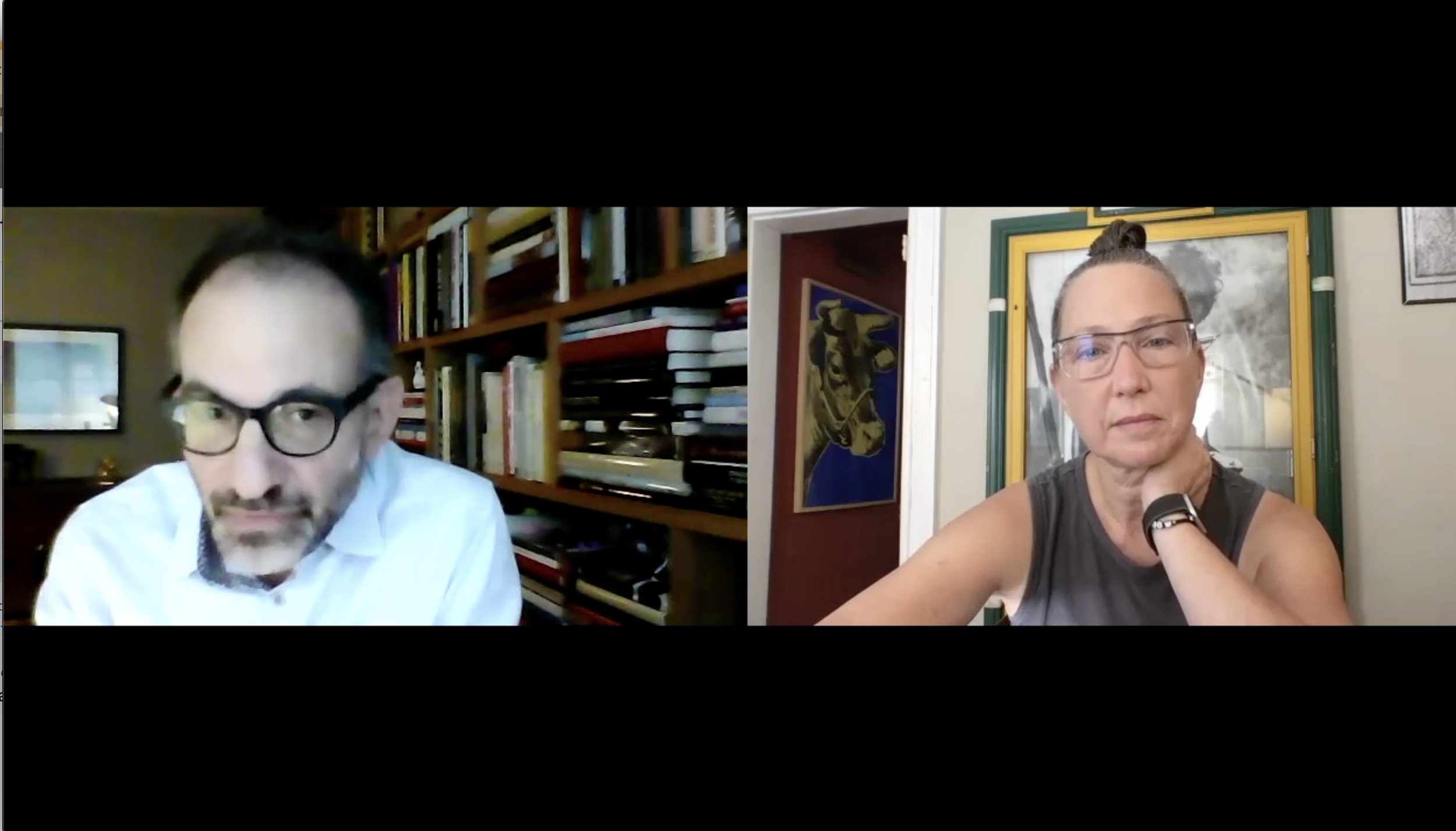
A Conversation with Nathan Kravis about his paper Charisma
Kravis and interviewer Terri C. Smith discuss Nathan Kravis’s paper Charisma, which was featured in our October 2021 issue. They explore themes such as how psychoanalysis informs understandings of charismatic authority, leadership/followership dynamics, and charismatic organization in the clinical practice. Read full article.
Nathan Kravis is Clinical Professor of Psychiatry at Weill Cornell Medical College, Associate Director of the DeWitt Wallace Institute of Psychiatry, and Training and Supervising Analyst at the Columbia University Center for Psychoanalytic Training and Research.